

If you’re in the business of running networks, managing cloud infrastructure, or scaling a high-volume email service, you already know the grim truth: IPv4 addresses are a scarce, high-priced commodity. With the global registries having exhausted their supply, any new address space you need must be acquired from the secondary market.
This scarcity has created a dangerous environment. When you acquire a block of IPv4 addresses, whether you buy it outright or secure a lease you aren’t just getting a string of numbers. You are buying the entire, unedited operational history of that block.
This history is what we call IP Reputation Debt.
If the previous owner used those IPs to run a “snowshoe” spam campaign, host malware, or launch denial-of-service attacks, that black mark is now burned into the databases of every major internet filter. Ignoring this debt transforms what looks like a simple OpEx decision (leasing) into a crushing liability that can stall your entire business.
The Hidden Tax: Where a Dirty IP Hurts Your Bottom Line
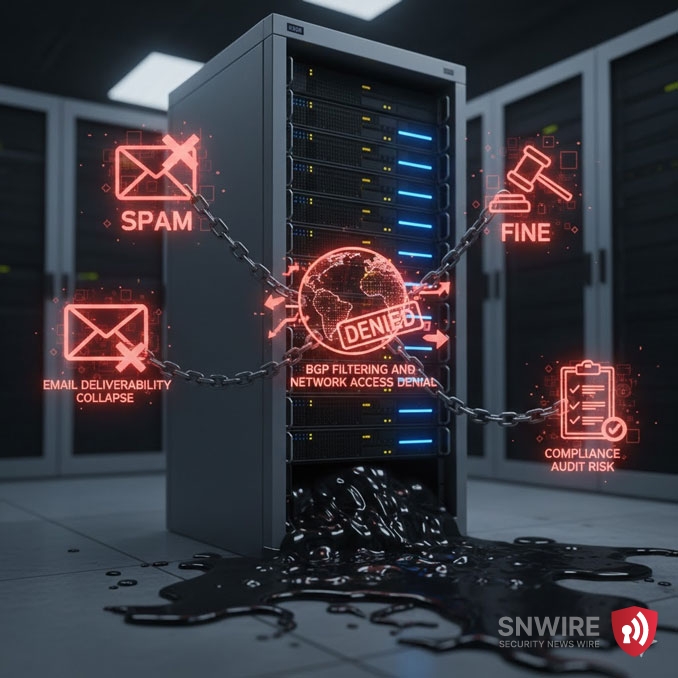
The fallout from acquiring a blacklisted IP block is immediate and far-reaching. This isn’t just a marketing problem; it’s an infrastructure failure that hits your revenue and security.
1. The Deliverability Crisis
The first and most painful place you’ll notice a problem is your email. Suddenly, all those mission-critical transactional alerts, sales leads, or onboarding emails are failing.
Mailbox providers like Google and Microsoft rely on dozens of DNSBLs (DNS-based Blackhole Lists)—like Spamhaus, SpamCop, and Barracuda—to filter traffic in real-time. If your new block is flagged on any of these, you lose:
- Trust: Customers who see your emails in the spam folder lose faith in your brand’s legitimacy.
- Compliance: You instantly fail to meet modern standards (like Google’s new 2025 mandate for spam rates below 0.3%).
- Time: You are forced to dedicate expensive engineering time to submitting delisting requests, only to be rejected because you can’t prove the root cause was fixed by the previous owner.
2. Network Denial and Service Outages
For mission-critical infrastructure, a bad IP can lead to total network failure. Tier 1 networks and major cloud providers often implement blanket filters. If your IPs are flagged as malicious, these networks simply refuse to route traffic to your prefix.
This means that your VPN servers, financial gateways, or entire co-location environments can be cut off from vast segments of the global internet, leading to crippling service outages and direct breaches of service level agreements (SLAs).
3. The Compliance Nightmare
If you operate in a regulated industry (healthcare, finance, government), you have zero tolerance for risk. A blacklisted IP block can trigger mandatory audits or security reviews. Regulators see a blacklisted IP as a failure of due diligence, exposing your organization to heavy fines and the potential loss of certifications like HIPAA or PCI-DSS.
The Two-Front War of IP Vetting
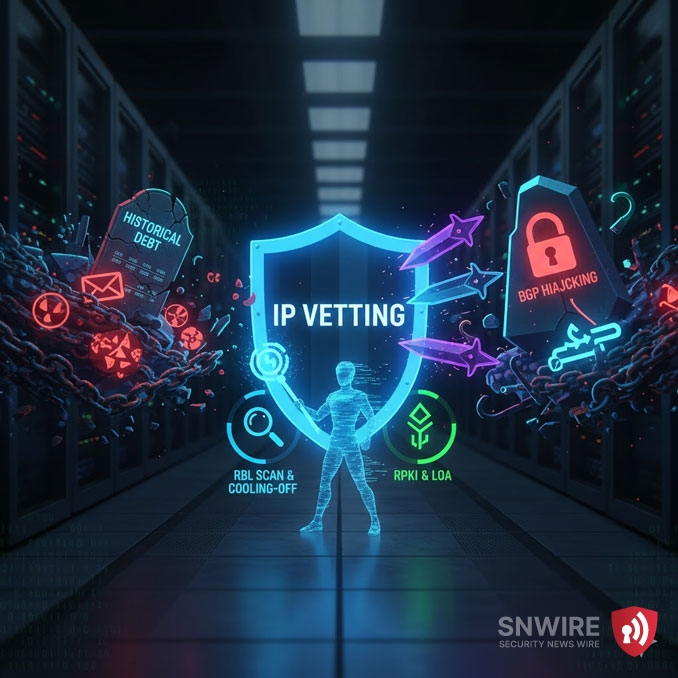
Reputation risk doesn’t just come from history. A robust vetting process must address two distinct threats: the past and the present.
Threat A: Historical Debt (The Blacklisting Risk)
This is the failure of the IP’s former user. It requires forensic historical research. Your job is to make sure you’re not leasing a block that was freshly abused and dropped on the market.
The Fix: You need proof that the previous bad behavior has been identified, purged, and has fully cycled out of the filter systems. This often means the block must sit dormant for a set time (a “cooling-off” period).
Threat B: Current Security Risk (The Hijacking Risk)
This is the failure of technical ownership. Today, any acquired IP block is a target for BGP Hijacking—where an attacker maliciously announces to the internet that they own your IP block, rerouting your traffic to their network for interception or denial of service.
The Fix: You need to adopt RPKI (Resource Public Key Infrastructure). RPKI acts like a digital deed, cryptographically proving that only your Autonomous System (AS) is authorized to announce that IP block. When a reputable broker transfers an IP block to you, you must ensure RPKI control is transferred immediately to lock out potential hijackers.
The 4 Non-Negotiable Steps of Due Diligence
To mitigate the IP reputation debt, the acquisition process must be treated as a rigorous risk management exercise, not a simple procurement order. This protocol is the baseline standard when evaluating managed leasing platforms or brokers.
1. Conduct the RBL Deep Scan
Don’t rely on a single, free IP lookup tool. Demand a comprehensive scan against all major DNSBLs.
- Action: If a block is flagged, your contract must be contingent on the seller providing written proof of delisting before the transfer is finalized.
- Focus: Look for the reason for the listing. Policy issues are minor; evidence-based listings (spam, malware) require the most scrutiny.
2. Verify the Legal Chain of Title (LOA)
You need absolute proof the seller has the legal right to give you the IPs.
- Action: Verify the ownership records via the relevant Regional Internet Registry (RIR) database (ARIN, RIPE, APNIC, etc.).
- The Crucial Document: Obtain a verified LOA (Letter of Authorization) signed by the registered resource holder. Without an LOA your upstream provider will refuse to announce your prefix via BGP, leaving you with useless IPs.
3. Confirm the “Cooling-Off” Period
Activity silence is a vital trust signal.
- Action: Request confirmation that the IP block has been unannounced (not advertised via BGP) for a minimum of 60 to 90 days. This cycle ensures the block has fallen off temporary blacklists and is truly “clean” of the previous tenant’s traffic noise.
4. Implement RPKI Immediately
This is your security lock on the asset.
- Action: Ensure the transfer agreement grants you immediate RPKI control. You must then use this control to create a Route Origin Authorization (ROA) certificate for the block. This crypto-validates your ownership and instantly protects your IP space from BGP hijacking attempts globally.
Conclusion: From Liability to Asset
The global IPv4 scarcity has changed the cost of doing business. IP addresses are now a high-value asset that requires the same level of due diligence as a real estate transaction.
The slight premium paid for a rigorously vetted IP block that guarantees a clean reputation, a valid LOA, and RPKI security is minimal compared to the costs of a single network outage or the catastrophic loss of email deliverability caused by acquiring IP Reputation Debt. Success in the modern digital economy requires partnering with infrastructure providers that prioritize compliance, security, and asset hygiene over raw volume or a low price.